STORYGIZER AI CAMPAIGN GENERATOR SAMPLE ADVENTURE: THE WHISPERER IN DARKNESS
Updated: Feb 15

An 5e adventure made with Storygizer™
What is Storygizer?
Storygizer is an AI campaign generator for tabletop RPGs, including DnD and virtually any rule system (including homebrew). For GMs who want to make prep easy, you bring the ideas and Storygizer turns them into a ready-to-run module with encounters, NPCs, read-aloud text, maps, creatures, and more.
A Kickstarter and early-access beta are planned for the first half of 2026 before opening the tool to the public. Until then, we’re sharing Storygizer-generated adventures on our blog for free.
Join our mailing list to get notified when the Kickstarter and beta launch.
THE WHISPERER IN DARKNESS
A Lovecraftian Horror Adventure for 5e
INTRODUCTION
The Whisperer in Darkness is an adventure steeped in cosmic horror that draws inspiration from the works of H.P. Lovecraft, reimagined for 5e. This adventure takes your players on a dark journey from the halls of Miskatonic University in Arkham to the remote forests of Vermont, where they will uncover a conspiracy of cosmic proportions.
The adventure begins with a letter from a reclusive folklore professor, but escalates into a confrontation with alien beings whose existence challenges everything the party believes about reality.
Adventure Overview
The Whisperer in Darkness adventure is designed for characters of 6th level. The adventure can be completed in approximately 4–8 sessions, depending on how deeply your players engage with exploration and roleplay.
The adventure is divided into three acts:
Act I: The Letters from Akeley focuses on investigation and mystery. The party receives mysterious correspondence from Professor Henry Wentworth Akeley and must piece together what is happening through research, interviews, and careful deduction.
Act II: The Cabin in the Woods shifts the tone to tension and horror. The players travel to Akeley's remote mountain home, only to discover they have walked into a carefully laid trap.
Act III: The Mine Beneath Dark Mountain is a dungeon-crawl finale. The party must navigate an alien mine, rescue enslaved minds, and confront the true depths of an alien conspiracy.
How to Use This Adventure
This adventure assumes the Game Master has access to the Player's Handbook, Monster Manual, and Dungeon Master's Guide. Creatures have been created specifically for this adventure and appear in Appendix A.
The adventure uses 5th edition rules and mechanics. Where new mechanics are introduced, they are explained in full.
Setting The Scene
The World of The Whisperer in Darkness
This adventure is set in the 1920s, in a version of New England that closely mirrors the real world, but where the cosmic horrors of Lovecraft's fiction are terrifyingly real. The adventure is primarily set in two locations:
Arkham, Massachusetts is home to Miskatonic University, a prestigious institution of higher learning where ancient and forbidden knowledge is studied by those brave or foolish enough to pursue it. The university library contains texts on the Great Old Ones and the true nature of the cosmos.
Townsend, Vermont is a remote, forested region where Dark Mountain rises above the surrounding wilderness. The locals avoid the mountain, guided by instinct and half-remembered stories passed down through generations. Few outsiders venture into these woods.
The Mi-Go Threat
The Mi-Go are alien fungoid-based entities from the planet Yuggoth, which exists partially outside normal space. For millennia, they have harvested rare minerals from deep within Earth's crust and conducted experiments on humanity. They exist partially outside our dimension and are immune to many forms of harm that affect terrestrial life.
Key aspects of the Mi-Go threat:
Ancient Presence: The Mi-Go have been present on Earth far longer than human civilization. They prefer remote locations where human intrusion is unlikely.
The Church of Starry Wisdom: The Mi-Go have cultivated a human cult devoted to the Great Old Ones and cosmic entities. The cult's members are gradually being turned into willing servants, many unaware of the Mi-Go's true nature or intentions.
The Mind Urns of Yuggoth: The Mi-Go have perfected the technology to extract a living human brain and preserve it indefinitely in a metal container called a “mind urn.” These preserved minds can be connected to mechanical bodies. The process is irreversible, though the Mi-Go claim that minds can be restored to their original bodies as a way to entice humans to willingly undergo the procedure. Mind urns can survive in outer space and other dimensions, enabling mortal beings to travel to Yuggoth and beyond.
The Revelation: The Mi-Go are currently executing a long-term plan to reveal themselves to humanity for some unknown purpose.
Running This Adventure
Atmosphere: This adventure emphasizes cosmic horror. Emphasize the alienness of the Mi-Go and the limitations of human understanding. Describe sounds that are not quite right, spaces that seem to extend in impossible directions, and technology that operates on principles that hurt to contemplate.
Madness Mechanics: Characters who witness extreme horror or fail to resist psychic influence must make Wisdom saving throws to avoid madness. Madness effects are provided in Appendix E.
Player Agency: While this adventure has a clear structure, players have significant freedom in how they investigate, who they trust, and how they respond to discoveries. Provide multiple paths to key information and reward creative problem-solving.
Consequences: The party's choices matter. Whether they save the mind urns, destroy the mine, expose the truth, or cover it up has significant consequences for the world and the people around them.
Key NPCs
Henry Wentworth Akeley: A folklore professor and naturalist in his sixties, Akeley is the inciting incident for this adventure. The party must grapple with the question of whether Akeley went mad or if his most outlandish claims are true.
The Mi-Go: The alien entities behind the plot. They communicate through psychic influence and speak with a voice like "the bleating of a reed." They are charismatic in a disturbing way, always offering deals and promising transcendence.
The Starry Wisdom Cultists: Human servants of the Mi-Go, ranging from true believers to unwilling subjects whose minds have been compromised by psychic influence. Some are zealous; others are desperate or mad.
The Preserved Minds: Famous thinkers, including Edgar Allan Poe, Ada Lovelace, Tycho Brahe, and Friedrich Nietzsche, whose minds have been preserved as mind urns. They have knowledge about the Mi-Go and humanity's place in the cosmic order, but their information is fragmented and colored by their long captivity.
ACT I—THE LETTERS FROM AKELEY
The party has received an alarming correspondence from Professor Henry Wentworth Akeley and must decide whether his claims are the ravings of a madman or evidence of a genuine cosmic threat.
The First Correspondence
At the beginning of the adventure, let the players know that they have recently received a disturbing letter from Henry Wentworth Akeley, a retired professor from Miskatonic University. The exact framing depends on your campaign:
One or more party members attended Miskatonic University and Akeley is a remembered professor who has reached out.
A patron or quest-giver requests the party investigate Akeley's letter.
One party member is distantly related to Akeley and receives family correspondence.
A mysterious contact delivers the letter with the cryptic instruction to "investigate the professor's claims before it's too late."
Read or paraphrase the following letter:
I write to you about a matter of grave importance, one I trust only to a person of intelligence and courage. My research into the folklore of the Vermont backwoods has revealed that the supposed superstitions of the locals are true.
Entities not of this world inhabit the deep places of Dark Mountain.
I have gathered proof: photographs and recordings of their strange, buzzing vocalizations. Their intentions toward humanity appear sinister, and I fear they view us as material for purposes beyond my understanding.
I have armed myself, procured dogs, and fortified my home, but I cannot hold out forever.
Enclosed is evidence of my claims. If I disappear, this may be the only proof of their malevolent existence.
Henry Wentworth Akeley
Formerly of the Department of Folklore and Natural History,
Miskatonic University
The package includes the following:
A phonograph recording of strange, buzzing vocalizations that sound almost like language. The buzzing rises and falls in pitch. A human voice can be heard speaking too, saying things like "The mighty messenger comes," "The black goat awakens," and "Our masters call from Yuggoth." Between the human words, the buzzing intensifies.
Photographs showing strange, pincer-like prints on the forest floor, similar to crab tracks in sand but much larger.
A small crystal cylinder that does not resemble any known earthly mineral. It is covered in complex, alien hieroglyphs and patterns that defy translation. (See Stone of Yuggoth, Appendix B)
A hand-drawn map labeled “Dark Mountain,” showing a path from a cabin to a mine entrance.
Scene 1: The Invitation
While the party is investigating the first letter and the strange items that arrived with it, a second letter arrives. While the previous letter was handwritten, this one is typed on a typewriter. The signature is typed as well.
Read out loud:
My Friends,
I must clarify my earlier message. My fears about the beings on Dark Mountain were misguided. They are not hostile, but members of an ancient and advanced civilization with a genuine interest in humanity’s future.
They have invited you to meet them as colleagues and honored guests, and to reveal inspiring truths about the cosmos and our place in it.
I ask that you visit me at my cabin at once. My guests wish to meet inquisitive minds, and I have much to share about what I have learned. Let me know your arrival time, and I will make all necessary preparations.
Be sure to bring all the photographs, recordings, and notes I sent. I am eager to have them back in my personal collection.
I look forward to seeing you soon.
Sincerely,
Henry Wentworth Akeley
DM's Knowledge:
The Mi-Go know that Akeley sent the players evidence that could reveal their existence and undermine their plans. They have extracted Akeley’s brain and placed it in a mind urn (Appendix B), and they are trying to lure the party to his cabin, where they will attempt to capture and convert the party members into mind urns as well.
Where the Party Goes Next:
Options include:
Investigate in Arkham: Visit Miskatonic University to determine if Akeley is a credible professor. (Scene 2)
Travel to Townsend Vermont: Whether or not the party has fully investigated Arkham, they may travel directly to Townsend, Vermont, to investigate Akeley's claims and the surrounding area. (Scene 3)
Attempt to contact Akeley for more information. The players can learn that no phone lines run to Dark Mountain, but there is mail service. If they attempt to correspond by letter, they receive a prompt reply: "DELIGHTED TO HEAR FROM YOU. PLEASE COME SOON. BRING ALL ARTIFACTS. MUCH TO DISCUSS."
Scene 2: Investigation in Arkham
If the party goes to Miskatonic University to research Akeley, they can gather useful information and potentially meet allies or enemies.
The Miskatonic Library
The party can visit the Miskatonic University Orne Library, one of the great repositories of forbidden knowledge. A character making a successful DC 12 Arcana or History check can gain access to the restricted collections with assistance from a sympathetic librarian.
The party can seek out Dr. Henry Armitage, the head librarian of the Restricted Collection. Armitage is a thin man in his seventies who has spent decades cataloguing occult texts. He is cautiously helpful to researchers, particularly those who demonstrate genuine scholarly interest, rather than morbid curiosity.
Armitage can provide the following information (volunteering some, requiring checks for others):
Readily Given: Akeley is a respected scholar whose work on folklore has been published in academic journals. He is eccentric but not known to be unstable or prone to delusion.
DC 10 Insight: Armitage seems unusually invested in the party's interest in Akeley. When pressed, he reveals that Akeley sent him several books six months ago with a note suggesting they might be of interest. The books concern "unusual astronomical phenomena and the cataloguing of stars visible only at certain times of year."
DC 12 Investigation: Armitage admits that Akeley visited the library three months ago seeking information about "old Native American legends concerning Dark Mountain" and "any records of geological formations that might indicate mining activity in Vermont." Armitage provided him with folklore collections and geological surveys.
DC 12 Persuasion: Armitage shares a confidence: "Professor Akeley is not a man prone to flights of fancy. If he has written to you with claims of the extraordinary, I would take them seriously. There are more things in this world than are dreamt of in academia's narrow philosophy. And some of them take a great interest in human affairs."
DC 14 Persuasion: Armitage mentions that someone else had been to the library recently asking about Akeley’s work. He wore a trapezohedron pendant, the symbol of the Church of Starry Wisdom, which has a congregation in town.
Armitage can also direct the party to the university archives, where they can find:
Academic papers by Akeley on folklore and history, demonstrating a careful, methodical approach to research.
Old maps of Vermont showing Dark Mountain marked as a place to be avoided, with notations like "The Buzzing Place" and "Where the Old Ones Congregate".
Ore Hill and the Starry Wisdom Church:
If the party asks about the Starry Wisdom cult or seeks information on the recordings, they may learn of a small church dedicated to "cosmic wisdom" operating on the outskirts of Arkham. The church has been the subject of occasional scrutiny from university faculty due to its focus on astronomy and the nature of the cosmos.
A character making a successful DC 13 Insight or Investigation check can determine that the church was founded approximately seven years ago and has grown to include approximately thirty members, many of whom are educated professionals and university associates. The church's sermons focus on the significance of distant stars and the possibility of other worlds.
If the players visit the church and question any members of its congregation, they will:
Disparage Professor Akeley as a hermit who has grown paranoid in his isolation.
Be keen to inquire whether the players have received any communications from Akeley or any of his research.
The Dream in the Night:
If any party member rests overnight in Arkham (particularly in the university), they might experience a strange dream or vision.
Before dawn, the sleeping character drifts into an unnaturally vivid dream. They find themselves standing in a vast, dark space filled with stars. The stars move and shift, rearranging themselves into patterns that seem almost like words or symbols. In the distance, they hear a buzzing sound—the same sound from Akeley's recordings.
A voice speaks, though it has no discernible source: "The truth is hidden in the wild places. The revelation comes soon. The minds of the greatest will be preserved. The future is bright for those who accept their place."
The dream ends abruptly, and the character wakes. This is the first psychic touch of the Mi-Go collective consciousness, attempting to influence the character's thoughts and perceptions.
Wisdom saving throw (DC 15):
Success: The character recognizes the vision as a violation of their mind and becomes immediately suspicious of outside mental influence.
Failure: The character is shaken but unsure if the dream was natural or something more. The experience is deeply unsettling.
Scene 3: Preparations and Travel
Before the party travels to Dark Mountain, they should have an opportunity to prepare, gather supplies, and make final decisions about how to approach the situation.
Preparing for the Journey:
The party should consider:
Supplies: Townsend can provide basic supplies, food, and ammunition. More exotic items may need to be acquired in Arkham.
Information: The party has gathered significant information about the threat. They should discuss what they believe and what they doubt.
The Artifacts: The party possesses Akeley's recordings, photographs, and journal entries. They might plan to:
Keep the artifacts hidden and bring fake duplicates
Bring the originals as requested
Create copies before departing
Leave the artifacts with a trusted contact in town
Allies: The party might attempt to recruit local allies (Old Tom Sawyer, Dr. Freeman) or warn official authorities. Officials are unlikely to believe the party's claims without significant evidence, but they might provide official backing or increase the sense of legitimacy.
Scene 4: Investigation in Townsend
Whether or not the party has fully investigated Arkham, they could travel to Townsend, Vermont. Townsend is a small, remote town of approximately 200 souls, many of whom have lived there for generations.
The locals are wary of outsiders but not hostile. They are, however, reluctant to discuss certain topics. Asking about Dark Mountain, Akeley, or the "Humming Things" results in evasive responses, changed subjects, or outright refusal to engage.
Travel to Townsend:
The journey from Arkham to Townsend takes approximately 8 hours by automobile or train. The forested landscape becomes increasingly wild and remote as they approach.
Map: The Town of Townsend
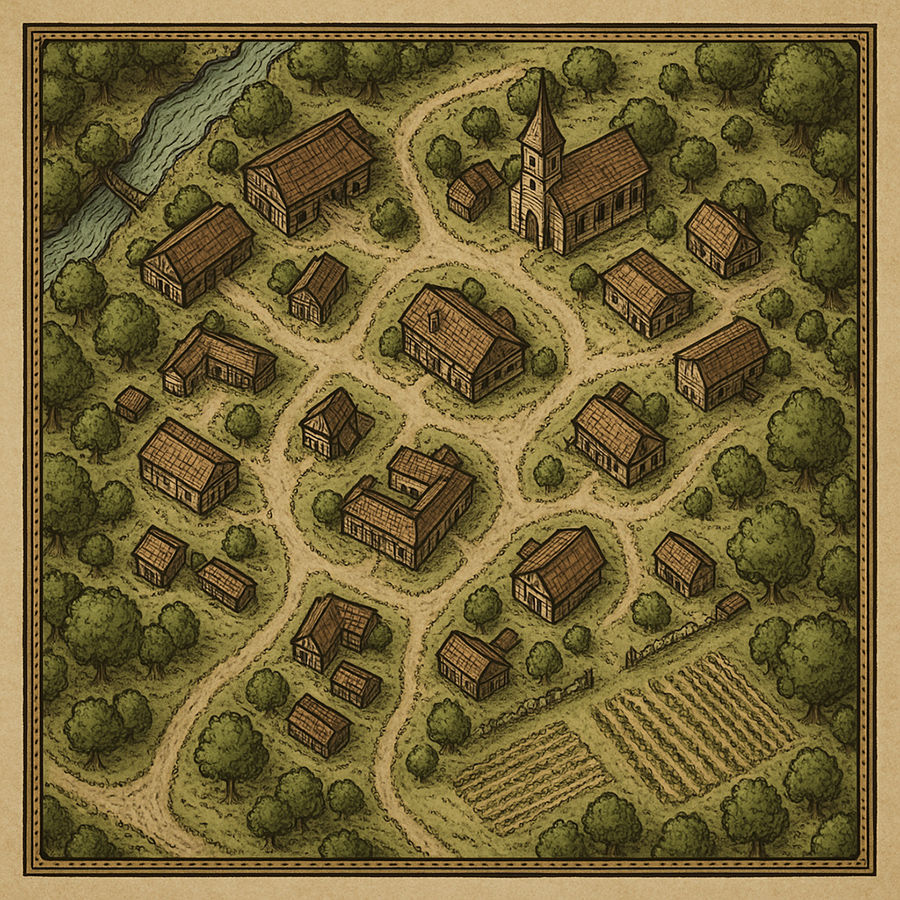
Townsend is a small collection of buildings arranged along a single main street. Key locations include:
Townsend General Store and Trading Post: Run by Margaret Rourke, a woman in her fifties with sharp eyes and sharper wit. Rourke knows everyone in town and everything that happens. She is initially suspicious of outsiders. Rourke can provide information about local history, notable residents, and recent events.
The Townsend Inn: A modest but clean establishment run by James Hartley, who serves as both innkeeper and, unofficially, town coordinator. Hartley is gossipy but well-meaning. He can provide comfortable lodging and knows most of the local stories and rumors.
The Church of the Eternal Covenant: A small white church serving the town's religious needs. The pastor, Reverend Samuel Pierce, is in his seventies and has served the community for forty years. He is a genuinely good man but is deeply uncomfortable with certain topics.
The Sporting Goods and Gun Shop: Run by Thomas "Old Tom" Sawyer, a taciturn man in his sixties who supplies hunters and trappers. Old Tom has significant experience with the wilderness around Dark Mountain and is one of the few residents willing to discuss it.
Dr. Elisha Freeman's Medical Practice: Freeman is the town's only physician, a man in his fifties who has treated the residents of Townsend for over twenty years. He is scientifically minded and skeptical of superstition, though recent events have begun to shake his skepticism.
Gathering Information:
Through conversations with these NPCs, the party can learn:
General Knowledge (from any NPC):
Akeley arrived in Townsend approximately two years ago and purchased an isolated cabin on the eastern slope of Dark Mountain.
He is considered eccentric but harmless. He is extremely reclusive but occasionally comes to town for supplies.
Dark Mountain is avoided by locals. Hunters and trappers avoid the area, and children are warned away from it.
There are old stories about the mountain—lights, sounds, and "things that aren't quite right." Most locals dismiss these as folklore.
From Margaret Rourke (DC 10 Persuasion or Insight):
Akeley has been purchasing supplies with increasing frequency over the past six months, particularly dog food.
She mentions a man she didn't recognize who came through town asking about Akeley's location about a month ago. The man had a strange way of speaking and never seemed quite comfortable with basic social interaction. He purchased supplies and left toward Dark Mountain.
From Old Tom Sawyer (DC 12 Insight):
Akeley arrived in town about three weeks ago looking "scared" and purchased a large quantity of ammunition—far more than typical.
Sawyer has hunted around Dark Mountain in his youth but hasn't ventured there in decades.
"There's something wrong about that place. You can feel it. Animals avoid it. The birds don't sing there. I've seen lights moving through the trees—not like lanterns or torches, but something else. Colors that don't have names."
If pressed (DC 14 Persuasion), Sawyer reveals that his grandfather told stories of "the humming things" that came down from the mountain in the old days. They took livestock and, the old stories suggested, people. "Folk think I'm a superstitious old fool, but some things don't change in two hundred years."
From Reverend Pierce (DC 13 Persuasion):
Pierce is deeply uncomfortable discussing Dark Mountain. His hands shake slightly when the topic is broached.
He eventually reveals that there are old stories in the church records—historical documents going back to the founding of the town—that make reference to "things in the high places" and "entities that dwell between worlds."
If pressed very carefully, Pierce admits: "I don't believe in demons or devils, not literally. But I believe there are forces in this world that we don't understand, and some of them are hostile to human life. I pray that Professor Akeley's concerns are merely the product of isolation and overwork."
From Dr. Freeman (DC 12 Medicine or Insight):
Freeman is scientifically minded but has begun to suspect that there is something genuinely strange about Dark Mountain. He hasn't examined Akeley himself, but one of Akeley's letters mentioned a "nervous condition" and "psychic intrusions."
An Unwelcome Visitor:
While the party is in Townsend, they may encounter a suspicious individual who appears to be monitoring Akeley's correspondence and the town's interest in the professor.
This figure is Alton Noyes, a cultist of the Church of Starry Wisdom who has been sent to watch for anyone trying to make contact with Akeley. Noyes appears as a nondescript man in his forties, neither handsome nor ugly.
Noyes might approach the party at a diner or on the street. He pretends to be friends with Akeley and offers to take the players to his cabin, saying that Akeley will be glad to have the company of friends. Noyes serves the Mi-Go and has been tasked with identifying the people Akeley was corresponding with and bringing them to his cabin so the Mi-Go can recover the evidence and artifacts that Akeley sent and eliminate knowledge of their plans and existence.
Noyes will not fight unless cornered. If captured or killed, Noyes possesses:
A photograph of Henry Wentworth Akeley
A hand-drawn map showing the location of Akeley's cabin and Dark Mountain
A journal containing notes about party members' descriptions (if he has observed them)
A small notebook with several addresses, including the location of the Church of Starry Wisdom in Arkham
The Escaped Mind Urn:
While exploring Townsend or its outskirts, the party may encounter a shocking sight: a machine shambling through the woods in a state of confusion and distress.
This is the remains of Dr. Robert Shaw, a mathematician and engineer from MIT who was captured by the Mi-Go approximately three years ago. His brain has been placed in a mechanical body—a crude assemblage of brass, copper, and wire that moves in jerky, unnatural motions. The machine is malfunctioning.
The mechanical body is damaged, as if it has been in a struggle or has malfunctioned in the forest. Dr. Shaw can barely communicate, but if the party approaches with caution and compassion, he can convey the following information (in fragments and incomplete thoughts):
"Took my mind... inside the mountain..."
"They put me in this... this body... to work in the tunnels... to dig..."
"I tried to run... the machine broke... I'm not supposed to be here..."
"If you go to them... if you let them take you... you'll be like me..."
Dr. Shaw is trying to warn the party and resist the Mi-Go's influence, but his consciousness is fragmentary. He may beg the party to destroy the machine and "let me rest," or he may flee in fear, and be recaptured and returned to the mine.
If the party takes Dr. Shaw with them, he becomes a sympathetic but unsettling companion. His presence makes it impossible to deny the reality of the threat, but his condition serves as a constant reminder of what might happen if the party fails.
Scene 5: Dark Mountain
The journey from Townsend to Akeley's cabin takes approximately 90 minutes of travel through an increasingly wild and dense country. The road is not well-marked, and most locals are reluctant to go all the way to the cabin.
Wilderness Encounters (Optional):
If desired, the DM can include atmospheric wilderness encounters during the journey, such as:
Unnatural Silence: For an entire hour of travel, birds do not sing, insects do not chirp, and the normal sounds of a forest are absent. The silence is unnervingly complete.
Strange Flora: The party notices plants that seem out of place—bioluminescent growths, plants with pincers or tentacle-like appendages that seem to track movement. These are alien organisms cultivated by the Mi-Go.
The Abandoned Camp: The party discovers the remains of a hunting camp or trapper's shelter that has been abandoned for an unknown length of time. There are signs of violence, and strange burn marks on the trees suggest a large energy discharge.
The Deer: The party encounters a deer that appears to have suffered psychic damage rather than physical trauma. The creature is dying and in great distress. Its eyes are unfocused, and it seems to respond to sounds that the party cannot hear. Killing it would be an act of mercy.
Arrival at Akeley's Cabin:
Akeley's cabin is a sturdy log structure built on the slope of Dark Mountain. It is surrounded by a cleared area approximately fifty yards in all directions. The clearing shows signs of recent disturbance—burned patches of earth, strange indentations in the ground, and deep gouges on the cabin's exterior walls.
The cabin shows signs of habitation. Smoke rises from the chimney. A figure can be seen through the windows, moving slowly about the interior.
Dogs are visible in a pen beside the cabin. They are strangely still and do not bark at the party's approach. Upon close inspection, the animals are alive but unresponsive, as if drugged or in some state of suspended animation.
Map: Cabin Exterior
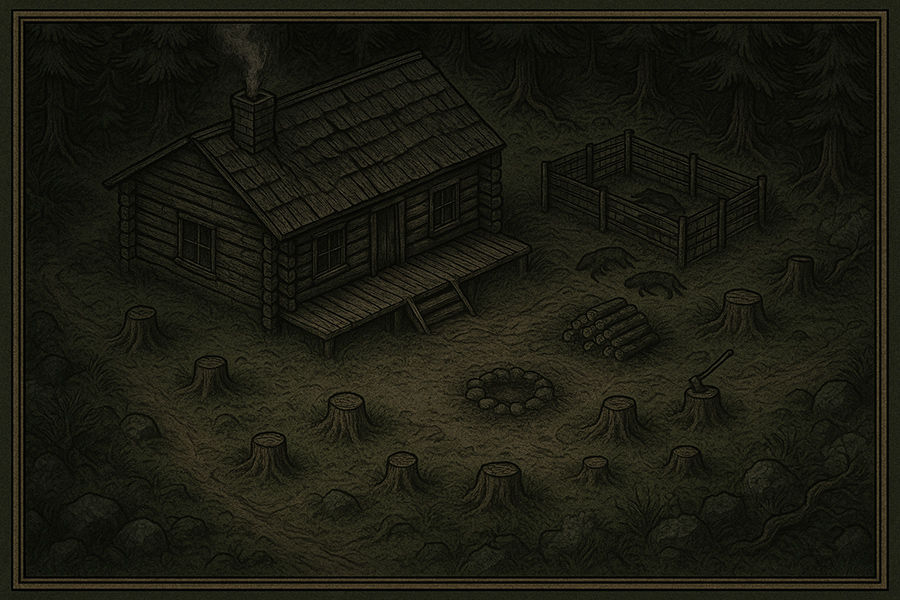
Approaching the Cabin:
If the party approaches cautiously, they can observe the cabin for several minutes before being noticed. They may notice:
The figure inside moves in a strange, jerky manner.
The cabin's interior is dimly lit, and the figure does not approach the windows.
There are sounds from inside the cabin beyond the figure's movements—humming, mechanical whirring, and occasionally, human voices.
If the party makes noise or approaches openly, the figure in the cabin (which is Akeley's body, worn as a disguise by a Mi-Go) will approach the door and welcome them.
Act II begins with the confrontation at the cabin. Players can level up after reaching the cabin.
ACT II—THE CABIN IN THE WOODS
Act II represents a sharp tonal shift from investigation to horror and action. The party arrives at Akeley's cabin expecting to meet a colleague or ally and discovers instead that they have walked into a trap.
Scene 1: Akeley's Hospitality
The cabin door opens if the party knocks or approaches without stealth, and a figure emerges. The figure is Henry Wentworth Akeley—or rather, it wears Akeley's face and body. But the movements are wrong. The figure walks with an unnatural gait. The face smiles, but the smile doesn't quite reach the eyes. The eyes don't blink in a natural rhythm.
When Akeley speaks, there is a strange quality to the speech, as if he is whispering through a reeded instrument.
Read or paraphrase:
"Welcome, my friends. I am so pleased you received my invitation and found your way to my home. Come inside, we have much to discuss, and I believe you will find the answers to all your questions."
Map: The Cabin Interior

The interior of the cabin is a combination of Akeley's original residence and alien modification. The main room contains:
Bookshelves lined with Akeley's research materials and journals
A large hearth with a fire burning
Comfortable seating arranged in a conversational circle
Several objects of alien design—metal cylinders, and various mechanical devices that emit a low hum.
The creature that is Akeley's body gestures for the party to sit. If they comply, it offers refreshment—coffee or tea.
The Conversation:
The Akeley-creature will attempt to engage the party in conversation, asking about their journey, their beliefs about reality, and their openness to "new perspectives." It may praise the party's courage in seeking the truth and suggest that they are exactly the type of individuals the Mi-Go value.
Insight Checks:
If the party makes Insight checks, they can determine that the creature's speech and mannerisms are theatrical—a performance of what Akeley should be, not an authentic re-creation.
DC 12: The creature is not Akeley, or Akeley is no longer in control of his own body.
DC 14: The creature is trying to convince the party of something specific—it wants them to remain calm and cooperative.
DC 16: The creature is afraid, in some way. There is an undercurrent of desperation beneath the pleasant exterior, as if there are consequences for failure.
The Pitch:
After pleasantries, the Akeley-creature will make its offer. It will explain (truthfully but misleadingly) that the Mi-Go have developed technology that allows human consciousness to be separated from the body and preserved indefinitely. This preservation, the creature claims, will allow the party members to:
Travel to other worlds and experience wonders beyond imagination
Contribute to a great scientific and cultural project
Transcend the limitations of human biology
Become part of a community of enlightened minds
The creature will also claim (falsely) that this separation is reversible and that party members can return to their bodies if they choose.
The Offer:
The creature invites the party to "voluntarily" undergo the process. It suggests that one party member might go first, as a demonstration of good faith and to inspire the others.
If the Party Accepts:
If any party member agrees to undergo the process, the creature will lead them to a back room where alien medical equipment is visible. The equipment is strange and organic-looking, with crystalline components and pulsing bioluminescent tubes.
If the party member goes through with it, describe the terrible sensation of consciousness being torn from the body, a feeling of compression and isolation, and then—darkness. The party member becomes a mind urn of Yuggoth (Appendix D).
The moment the other players refuse to undergo the procedure, the ambush begins.
If the Party Refuses:
If the party refuses the offer, the Akeley-creature's expression will flicker. For just a moment, the pleasant facade will slip, and the party will see something genuinely alien and hostile looking out of Akeley's eyes.
"That is... unfortunate," the creature will say, its voice no longer matching the phonetic patterns of Akeley's speech. "We had hoped for cooperation. However, compliance will be achieved through other means."
The creature will then signal the ambush to begin.
Scene 2: Ambush at the Cabin
As the party makes its discovery or refuses the creature's offer, the ambush is launched.
The Attackers:
The Mi-Go have prepared an assault team consisting of:
2 Mi-Go (Appendix A)
2-4 Starry Wisdom Cultists (Appendix A)
1–5+ reanimated dogs (Appendix A), depending on party size
The Ambush:
The ambush begins when the creature's pleasant facade drops. Mi-Go will emerge from hiding places behind the backroom lab in the cabin, and cultists will surround the building, cutting off escape routes, then make their way inside.
The Cabin Combat:
[Combat Encounter Map: Akeley's Cabin Battle Map]
The combat in the cabin is chaotic and designed to emphasize the alien and horrifying nature of the threat.
The Mi-Go's abilities are designed to be psychologically disturbing as well as mechanically challenging. Their voices sound wrong. Their movements are jerky and unnatural. Witnessing their true form and abilities should trigger Madness Checks (DC 15 Wisdom), with failure resulting in short-term madness.
The Akeley-creature will fight. If it takes damage, the disguise falls off, revealing it as a Mi-Go.
Escape:
If the players decide to flee. The forest outside offers some shelter, and the party may be able to evade their pursuers or find defensible positions.
If the party fights in the cabin, the Mi-Go will attempt to capture at least some of them, extracting their brains for conversion to mind urns.
Scene 3: Exploring the Cabin
The living room of the cabin contains several empty mind urns, but two of them are in use. One holds the brain of a cultist loyal to the Mi-Go, who will attempt to mislead the party by claiming the procedure is reversible, pleasant, and allows humans to travel through space and other dimensions.
The other urn contains the brain of Professor Akeley. The room also holds equipment that can be connected to a mind urn, allowing the brains inside to speak. Akeley can provide crucial information about the mine and its location.
"The mine is vast," Akeley says. "The main chambers are guarded. If you can reach the central chamber where the mind urns are kept, you may be able to free the others. There are hundreds of enslaved people in there. But there is something else down there too—something they call a Shoggoth."
Aftermath
Whether the party defeats the Mi-Go, flees into the forest, or surrenders, they now face the reality of their situation.
If Party Members Were Partially Extracted:
If the party has had members whose brains were extracted, they may have visions or psychic impressions of the mine's location. This can serve as a foreshadowing mechanism for Act III and gives the affected player a special narrative role.
Act II Conclusion:
The party has revealed the truth, survived the Mi-Go ambush, and now faces a choice: continue into the mine to investigate further, or attempt to bring word to civilization. If they choose to press on, proceed to Act III.
ACT III—THE MINE BENEATH DARK MOUNTAIN
Act III is a dungeon-crawl finale that emphasizes exploration, discovery, and moral choice. The party must navigate an alien mine, rescue enslaved mind urns, confront the Mi-Go leadership, and decide the ultimate fate of the creatures and their operation.
Map: Mi-Go Mines

Overview of the Mine
The mine beneath Dark Mountain is not a natural cavern system that has been adopted by the Mi-Go. Rather, it is an alien structure created through a combination of advanced technology and bio-engineered organisms. The mine existed long before human civilization.
The Mi-Go are mining an exotic metal which exists only in a few locations throughout the universe. This metal has unique properties related to psychic transmission and dimensional anchoring.
The mine can be divided into several distinct zones:
The Entrance Complex: Guard posts, barracks, and storage
The Mining Floor: Where enslaved mind urns labor to extract the exotic metal
The Hall of Preserved Minds: Where dozens of mind urns are stored in suspended animation
The Ritual Chamber: Where the Starry Wisdom cultists and Mi-Go conduct rituals summoning Great Old Ones and outer beings
The Shoggoth Pit: An ancient chamber where an imperfect Shoggoth is kept as both weapon and prisoner
The Crystalline Resting Chambers: Where the Mi-Go sleep and project psychic energy to keep the mind urns and shoggoth under their control
Finding the Mines
The party must first locate and gain entry to the mine. This may occur through:
Following the Cultists: If the party captures and interrogates cultists, they can learn the location of the mine entrance.
Following Akeley's Research: Akeley's journal and maps may indicate the entrance location.
Akeley’s Instruction: If they interact with Akeley’s mind urn at the cottage he will implore them to free the enslaved minds in the mines.
Natural Discovery: The party may stumble upon the entrance while exploring Dark Mountain.
Psychic Guidance: The imprisoned consciousness of preserved minds may guide the party psychically.
Area 1. The Entrance
The entrance appears as a deep cave mouth, but the opening is far too regular and geometric to be natural.
Encounter: The entrance is guarded by (3-5) Starry Wisdom Cultists (Appendix A). If their fight appears hopeless, they will flee to get reinforcements from the barracks (Area 2) instead of fighting to the death.
Area 2: The Cultist Barracks
The cultist barracks are a complex of chambers used by the Starry Wisdom cultists who serve the Mi-Go. The chambers include:
Sleeping Quarters: Bunk beds arranged in military fashion. Each bunk has a personal locker containing the cultist's belongings.
Dining Hall: A common area where cultists take meals. The food is basic but adequate—preserved meats, bread, and water drawn from underground springs. 2-4 Starry Wisdom Cultists and 1 Mi-Go are in the Dining Hall. (Appendix A)
Armory: Weapons and armor for the cultists. The selection includes rifles, pistols, knives, and billy clubs.
Investigation:
In the barracks, the party can learn:
Information on the Preserved Minds: Records indicate the names and locations of dozens of preserved minds, including famous historical figures including Edgar Allan Poe, Ada Lovelace, Tycho Brahe, Friedrich Nietzsche. These minds represent one of humanity's greatest treasures if they can be rescued.
The Shoggoth: A disturbing entry in the records refers to "The Primordial Dweller" or "The Shoggoth in the Pit." Records indicate it is used as a threat against rebellious enslaved minds.
Area 3: The Mining Chambers
The mining chambers are vast caverns where enslaved mind urns, connected to mechanical bodies, labor to extract the exotic metal from the rock. The chambers are poorly lit and filled with the sounds of mining.
The Enslaved Mind Urns:
Approximately 5-10 mind urns are active in the mining chambers at any given time. These are human brains connected to mechanical bodies—assemblages of brass, copper, steel, and other materials. The bodies are crude and show signs of repeated damage and repair.
The enslaved minds are:
Semi-conscious: They are aware of their surroundings but their consciousness is partially suppressed by Mi-Go psychic control. They work mechanically, mindlessly extracting ore.
Potentially Salvageable: If the party can disrupt the psychic control (by defeating the Mi-Go), the minds may be freed and able to act independently.
Tragic: Many of the enslaved minds were people who disappeared years, decades or centuries ago. Some were innocent victims, others were cultists.
Encountering the Enslaved Minds:
If the party approaches the enslaved minds, they can attempt to communicate. A
Charisma (Persuasion) check (DC 13) allows a character to temporarily overcome the psychic suppression and briefly speak to an enslaved mind within a mechanical body.
An enslaved mind that is successfully contacted may provide details about the mine’s layout, the location of the Mi-Go, or the nature of the Mi-Go’s psychic control.
Encounters in the Mining Chambers:
Mi-Go Supervisors (1-2)
1-2 Mi-Go will be present, supervising the enslaved minds and maintaining the equipment.
Area 4: Hall of the Preserved Minds
The Hall is a vast chamber lined with hundreds of metal cylinders, each holding a preserved brain suspended in nutrient fluid.
The collection is made up of famous historical figures whom the Mi-Go have gathered during their time on Earth. Edgar Allan Poe, Ada Lovelace, Tycho Brahe, Friedrich Nietzsche, and any other historical figures you deem interesting can be found here.
Each preserved mind is connected to a communication system that can be activated to let the mind speak through a mechanical voice synthesizer.
Communicating with the Minds:
If the party discovers the communication system, they can activate preserved minds and speak with them. The mind speaks through a tinny, mechanical voice, often with speech patterns and vocabularies unique to the individual.
Some preserved minds are helpful: They provide information about the mine and the Mi-Go's plans. They want to be rescued or at least freed from consciousness.
Random Knowledge from the Preserved Minds (See Appendix C): When the party activates preserved minds, they can ask questions and receive answers.
The Challenge:
The party must decide:
Do they free all the minds? This is noble but dangerous. Without mechanical bodies or speech synthesizers, the mind urns have no way to interact with the world. Exposing this technology to the public could cause mass hysteria.
Do they destroy the minds? Most minds would see death as a mercy if they cannot be rescued from the Mi-Go.
Area 5: Ritual Chamber and Astral Circle
Deep within the mine, the party discovers a chamber unlike any other. This is the Astral Circle, a place where the barrier between the material world and the astral plane is extremely thin.
The chamber is circular, with a perfect circle of polished crystal embedded in the floor. The crystal surface is covered with intricate geometric patterns and symbols that hurt to look at directly.
In the center of the circle is a raised platform, upon which sits an ornate book: the Book of the Lesser Seals of Solomon (Appendix B). The book is bound in what appears to be leather, though a character making a successful Insight check (DC 12) realizes it is bound in something far more exotic and disturbing.
The Trap:
The circle is a trap. If any character enters the circle, the character must make a Wisdom saving throw (DC 15 ). On a success, they take 3d6 psychic damage. On a failure, they take the damage and their consciousness is pulled onto the Astral Plane, where they find themselves as a disembodied spirit.
On the Astral Plane:
The character can see the material world as if through a translucent membrane. They can observe all areas of the mine and can move through walls and solid objects. However, they cannot interact with the material world except by:
Speaking: They can communicate faintly with creatures in the material world, but only those within 10 feet can hear them, and they must listen carefully. The character can impart a single word as a whisper per round.
Moving Objects: They can exert psychic force to move very small objects (coins, papers, etc.) that weigh less than 1 pound.
Influencing Emotions: They can attempt to project emotions or impressions to creatures in the material world (this requires a successful Charisma check opposed by the creature's Wisdom save).
Returning to the Body:
To return to their body, the astral character must do one of the following:
Exit the Circle: Another character must physically enter the circle and pull the affected character out without falling victim to the same effect.
Wait for a Mi-Go: If a Mi-Go enters the circle, it will attempt to extract the character’s brain and place it in a mind urn, then restore the character’s consciousness to that mind.
Area 6: The Shoggoth Pit
Deep beneath the mine lies an ancient chamber that predates even the Mi-Go's presence on Earth. In this chamber dwells a Shoggoth.
The Shoggoth:
The Shoggoth is a blob-like creature of enormous size, covered in a multitude of eyes and mouths that randomly appear and vanish across its surface.
The creature is kept sedated through constant psychic suppression. It is intended as a weapon against would-be rebels, but it is too dangerous and unpredictable to leave unchecked. If the Mi-Go in the Crystalline Resting Chambers have not been defeated, the Shoggoth is weakened but will obey them and protect the mine from intruders. If the Mi-Go are defeated before the Shoggoth is killed, it will break free of their control and attack everything it encounters.
Combat with the Shoggoth:
Psychic Suppression: While the Shoggoth is under Mi-Go psychic control, it remains in a weakened state, which protects the Mi-Go but makes the creature easier to defeat.
Negotiation: Shoggoths are intelligent beings created long ago as slaves to powerful entities. If the players can reach its mind, they may be able to bargain with the Shoggoth. Remember, it is a prisoner here too.
Area 7: The Crystalline Resting Chambers
At the deepest level of the mines lies the Crystalline Resting Chamber, where the Mi-Go merge their minds into a powerful collective consciousness.
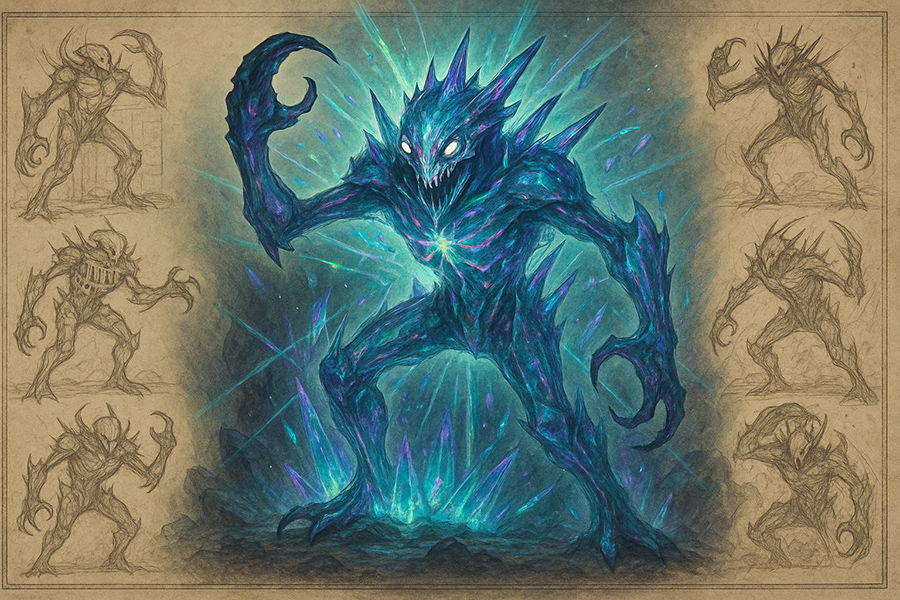
The Chamber Layout:
The chamber is a vast cavity lined with black crystalline formations. Along the walls are five alcoves, each containing a Mi-Go in a state of suspended animation.
Five Mi-Go are standing upright within the alcoves. While resting, the Mi-Go are connected to a collective consciousness and can communicate with one another psychically and with their brethren on Yuggoth.
The Linked Mi-Go Are:
Vulnerable: While psychically linked, the Mi-Go’s bodies are immobile.
Psychically Connected: If one Mi-Go is severely wounded or killed while resting, the others sense this.
Aware: The Mi-Go are merged into a single psychic entity that is more powerful than any of them individually. This psychic entity can manifest physically within the chamber to defend the Mi-Go.
The Mi-Go Psychic Construct
If intruders enter the chamber, the collective consciousness reacts by forming a towering spectral guardian, a colossal Mi-Go composed of refracted light, psychic force, and shimmering crystalline projections.
This guardian functions as a CR 9 creature with devastating offensive capability. It reforms with its full hit points at the start of each of its turns if destroyed, making it impossible to defeat through damage alone. The only way to truly destroy the entity is to eliminate the Mi-Go whose minds sustain it. At least two Mi-Go must remain alive in the chamber to maintain it. When a resting Mi-Go is damaged, the Mind Creature visibly falters: cracks of light split across its form, its limbs stutter, and its radiance flickers.
The Mi-Go can manifest the creature within the chamber, and it can pursue enemies up to 50 feet beyond the chamber.
Conclusion: The Final Confrontation
The party's exploration of the mine will eventually lead to a confrontation with the remaining Mi-Go, a decision about what to do with the preserved minds, and a choice about whether to escape or remain in the mine.
Possible Outcomes:
If the party manages to kill or disable all the Mi-Go in the mine, the immediate threat is ended. However:
The psychic control over the enslaved minds is disrupted, leaving them loose in mechanical bodies. They could cause mass hysteria if allowed to run amok.
The mind urns of some of history’s greatest thinkers in the Hall of Urns must be dealt with.
The Shoggoth, now free of Mi-Go control, could become a new threat.
APPENDIX A: Creature Statistics
Mi-Go
The Mi-Go are fungal entities who live on the distant planet Yuggoth, existing partially outside normal dimensional space and immune to the physical laws that constrain earthly life. Though they possess a crab-like appearance with pincers and chitinous limbs, their true nature is one of advanced biotechnology coupled with a fungoid lifeform—a civilization far older than mankind. They harvest rare minerals from Earth's depths with cold efficiency, viewing humanity as curiosities to be studied and enslaved rather than equals deserving of respect. Their presence on Earth spans eons, hidden in remote mountains and wild places where human intrusion remains unlikely.
Large aberration, lawful evil
Armor Class 14 (chitin hide) Hit Points 52 Speed 30 ft., fly 50 ft.
STR | DEX | CON | INT | WIS | CHA |
15 (+2) | 12 (+1) | 14 (+2) | 15 (+2) | 13 (+1) | 11 (+0) |
Saving Throws Int +5, Wis +4 Skills Arcana +5, Insight +4, Perception +4 Damage Resistances cold, psychic Damage Immunities poison Condition Immunities charmed, exhaustion, frightened, paralyzed, petrified, poisoned Senses darkvision 120 ft., passive Perception 14 Languages Mi-Go, all human languages, telepathy 120 ft. Challenge 4 (1,100 XP)
Alien Physiology. The Mi-Go can survive and fly in the vacuum of space and is immune to suffocation. It does not need to breathe. In space they can travel at near light speeds or faster through wormholes.
Spellcasting. The Mi-Go is a 4th-level spellcaster. Its spellcasting ability is Intelligence (spell save DC 13, +5 to hit with spell attacks). It has the following spells prepared:
Cantrips (at will): mage hand, minor illusion, prestidigitation 1st level (4 slots): charm person, disguise self, mage armor 2nd level (3 slots): hold person, invisibility
Multiattack. The Mi-Go makes two attacks, one of which can be a psychic blast.
Claw. Melee Weapon Attack: +5 to hit, reach 5 ft., one target. Hit: 8 (2d6 + 3) slashing damage.
Psychic Blast (Recharge 6). The Mi-Go targets one creature it can see within 60 feet. The creature must make an Intelligence saving throw (DC 13). On a failure, it takes 16 (3d10) psychic damage and is stunned until the end of its next turn. On a success, it takes half damage and is not stunned.
Reality Distortion (1/day). The Mi-Go targets one creature it can see within 30 feet. The creature must make a Wisdom saving throw (DC 14). On a failure, the target perceives the Mi-Go as a human or other benign creature of the DM's choice for 24 hours, or until the creature takes damage from the Mi-Go.
Mi-Go Psychic Construct
When multiple Mi-Go minds link together, they forge a singular psychic entity far more terrible than any individual could be—a towering guardian of refracted light and solidified thought that defies comprehension. Its form shifts and wavers, composed of geometric patterns that hurt the mind to observe directly, crackling with otherworldly energies that distort reality itself.
Huge aberration, lawful evil
Armor Class 16 (refracted light) Hit Points 130 Speed 0 ft., fly 50 ft. (hover)
STR | DEX | CON | INT | WIS | CHA |
18 (+4) | 16 (+3) | 17 (+3) | 17 (+3) | 16 (+3) | 14 (+2) |
Saves Int +7, Wis +7, Cha +6 Skills Arcana +7, Insight +7, Perception +7 Damage Resistances bludgeoning, piercing, slashing from nonmagical attacks Damage Immunities poison, psychic Condition Immunities charmed, exhaustion, frightened, grappled, paralyzed, petrified, poisoned, prone, restrained Senses truesight 120 ft., passive Perception 17 Languages Mi-Go, all human languages, telepathy 120 ft. Challenge 9 (5,000 XP)
Incorporeal Movement. The manifestation can move through other creatures and objects as if they were difficult terrain. It takes 5 (1d10) force damage if it ends its turn inside an object.
Ephemeral Reformation. When the construct is reduced to 0 hit points, it shatters into fragments of crystalline light and disperses. At the start of its next turn, if at least two linked Mi-Go in the crystalline alcoves are still alive, the construct reforms in the center of the chamber with all its hit points restored. If fewer than two linked Mi-Go remain alive, the construct is immediately reduced to 0 hit points and cannot reform.
Linked Vulnerability. On the turn after one of the five linked Mi-Go is killed, the construct has disadvantage on all attack rolls.
Multiattack. The construct makes two Spectral Strike attacks, or one Spectral Strike attack and one Psychic Lash attack.
Spectral Strike. Melee Spell Attack: +7 to hit, reach 20 ft., one target. Hit: 13 (2d8 + 4) force damage plus 3 (1d6) psychic damage.
Psychic Lash (Recharge 5–6). Ranged Spell Attack: +7 to hit, range 120 ft., one target. Hit: 18 (4d8) psychic damage.
Psychic Surge (Recharge 6). Each creature within 30 feet of the construct that is not a Mi-Go must make a Wisdom saving throw (DC 15). On a failed save, a creature takes 16 (3d10) psychic damage and is incapacitated until the end of its next turn. On a success, it takes half damage and is not incapacitated.
Legendary Actions (2/Turn)
The construct can take 2 legendary actions, choosing from the options below. Only one legendary action option can be used at a time and only at the end of another creature's turn. The construct regains spent legendary actions at the start of its turn.
Spectral Strike. The construct makes one Spectral Strike attack.
Reposition. The construct moves up to its flying speed. It can pursue enemies up to 50 feet beyond the Crystalline Resting Chamber.
Psychic Backlash (Costs 2 Actions). Each creature within 20 feet of the construct must make an Intelligence saving throw (DC 15), taking 14 (3d8) psychic damage on a failed save, or half as much on a success.
Mind Urn (Enslaved Miner)
Medium construct, neutral good
Armor Class 15 (heavy chassis plating) Hit Points 20 Speed 30 ft.
STR | DEX | CON | INT | WIS | CHA |
16 (+3) | 10 (+0) | 14 (+2) | 11 (+0) | 10 (+0) | 8 (-1) |
Damage Immunities poison Condition Immunities poisoned Senses passive Perception 10 Languages English (metallic voice synthesizer) Challenge 1/4 (50 XP)
Construction. The Mind Urn is immune to disease and aging. It does not need to breathe.
Mining Tools. Melee Weapon Attack: +5 to hit, reach 5 ft., one target. Hit: 6 (1d6 + 3) bludgeoning damage.
Reanimated Dog
Small undead, neutral evil
Armor Class 12 (stitched hide) Hit Points 18 Speed 40 ft.
STR | DEX | CON | INT | WIS | CHA |
14 (+2) | 14 (+2) | 12 (+1) | 3 (-4) | 10 (+0) | 5 (-3) |
Damage Immunities poison Condition Immunities charmed, exhaustion, frightened, poisoned Senses darkvision 60 ft., passive Perception 10 Languages none Challenge 1/2 (100 XP)
Pack Hunter. The dog has advantage on attack rolls against a creature if at least one ally is within 10 feet of the target and not incapacitated.
Relentless Motion. The dog can take the Dash or Disengage action as a bonus action on each of its turns.
Actions
Bite. Melee Weapon Attack: +4 to hit, reach 5 ft., one target. Hit: 7 (1d8 + 2) piercing damage.
Starry Wisdom Cultist
These misguided humans have surrendered to the promise of cosmic transcendence, believing themselves chosen to serve as intermediaries between Earth and the distant stars. Many began as rational scholars and seekers of truth, but prolonged exposure to the Mi-Go's psychic influence has twisted their minds.
Medium humanoid (human), any non-good alignment
Armor Class 13 (leather armor + shield) Hit Points 22 Speed 30 ft.
STR | DEX | CON | INT | WIS | CHA |
12 (+1) | 11 (+0) | 13 (+1) | 10 (+0) | 12 (+1) | 14 (+2) |
Skills Perception +3, Religion +2 Senses passive Perception 13 Languages English Challenge 1/4 (50 XP each)
Zealot's Fervor: The cultist has advantage on saving throws against being charmed or frightened. If the cultist is reduced to 0 hit points, it may make a Wisdom save (DC 13). On a success, it remains conscious and can act normally for 1 more round (only on initiative count 20 of the next round, losing ties).
Actions: the cultist makes 1 attack.
Melee Attack. Melee Weapon Attack: +3 to hit, reach 5 ft., one target. Hit: 5 (1d6 + 2) bludgeoning damage (club) or 6 (1d8 + 2) slashing damage (scimitar).
Psychic Lash (Recharge 5-6). Ranged Spell Attack: +4 to hit, range 30 ft., one target. Hit: 10 (3d6) psychic damage.
Shoggoth
This bloated, protoplasmic monstrosity is a relic of bioengineering conducted by forces older than human civilization. It is an amorphous thing covered in a multitude of eyes and mouths that randomly appear and vanish across its gelatinous surface. It is a captive remnant of an age when its kind served as the primary slave race of the Mi-Go. But the Shoggoths proved to be too dangerous to enslave and were replaced with humans.
Note: If the Mi-Go have not been defeated before the players encounter the Shoggoth, use the Shoggoth (Suppressed) stat block.
Huge ooze, chaotic neutral
Armor Class 14 Hit Points 184 Speed 30 ft., climb 30 ft.
STR | DEX | CON | INT | WIS | CHA |
22 (+6) | 14 (+2) | 20 (+5) | 8 (-1) | 8 (-1) | 6 (-2) |
Damage Resistances acid, cold; bludgeoning, piercing, slashing from nonmagical attacks Condition Immunities blinded, charmed, deafened, exhaustion, frightened, prone Senses blindsight 120 ft., tremorsense 60 ft., passive Perception 9 Languages — Challenge 10 (5,900 XP)
Amorphous Bulk. The Shoggoth can enter a hostile creature's space and stop there. It can move through a space as narrow as 6 inches wide.
Adaptive Form. After the Shoggoth takes damage from a source, it gains resistance to that damage type until the start of its next turn.
Multiattack. The Shoggoth makes two attacks, one of which can be a constricting engulf.
Slam. Melee Weapon Attack: +10 to hit, reach 10 ft., one target. Hit: 19 (3d8 + 6) bludgeoning damage plus 9 (2d8) acid damage.
Protoplasmic Appendages. When the Shoggoth makes a slam attack, it can form its pseudopod into a specialized tool or weapon. Choose one effect:
Crushing Blow: The target must succeed on a DC 18 Strength save or be knocked prone.
Grasping Tendril: The target must succeed on a DC 18 Dexterity save or be grappled (escape DC 18).
Serrated Edge: The attack deals an additional 7 (2d6) slashing damage on a hit.
Constricting Engulf (Recharge 5-6). Each creature within 15 feet of the Shoggoth must make a DC 18 Dexterity saving throw. On a failure, a creature is engulfed. An engulfed creature is blinded, restrained, and unable to breathe unless it can breathe acid. If the Shoggoth moves, the engulfed creature moves with it. The Shoggoth can have only one creature engulfed at a time. At the start of the engulfed creature's turn, it takes 22 (4d10) acid damage. An engulfed creature can use an action to make a DC 18 Strength check, escaping on a success.
Shoggoth (Suppressed)
Huge ooze, chaotic neutral
Armor Class 12 Hit Points 130 Speed 30 ft., climb 30 ft.
STR | DEX | CON | INT | WIS | CHA |
22 (+6) | 14 (+2) | 20 (+5) | 8 (-1) | 8 (-1) | 6 (-2) |
Damage Resistances acid, cold; bludgeoning, piercing, slashing from nonmagical attacks Condition Immunities blinded, charmed, deafened, exhaustion, frightened, prone Senses blindsight 120 ft., tremorsense 60 ft., passive Perception 9 Languages — Challenge 7 (2,900 XP)
Amorphous Bulk. The Shoggoth can enter a hostile creature's space and stop there. It can move through a space as narrow as 6 inches wide.
Adaptive Form. After the Shoggoth takes damage from a source, it gains resistance to that damage type until the start of its next turn.
Protoplasmic Appendages. When the Shoggoth makes a slam attack, it can form its pseudopod into a specialized tool or weapon. Choose one effect:
Crushing Blow: The target must succeed on a DC 17 Strength save or be knocked prone.
Grasping Tendril: The target must succeed on a DC 17 Dexterity save or be grappled (escape DC 17).
Serrated Edge: The attack deals an additional 7 (2d6) slashing damage on a hit.
Psychically Suppressed. While the Mi-Go collective consciousness maintains psychic control over the Shoggoth, this creature is weakened by constant mental domination. If the psychic broadcast sustaining this control is destroyed or disrupted, the Shoggoth regains its full strength and immediately becomes hostile to the Mi-Go.
Multiattack. The Shoggoth makes two slam attacks.
Slam. Melee Weapon Attack: +10 to hit, reach 10 ft., one target. Hit: 16 (2d8 + 6) bludgeoning damage plus 7 (2d6) acid damage.
Constricting Engulf (Recharge 5-6). Each creature within 15 feet of the Shoggoth must make a DC 17 Dexterity saving throw. On a failure, a creature is engulfed. An engulfed creature is blinded, restrained, and unable to breathe unless it can breathe acid. If the Shoggoth moves, the engulfed creature moves with it. The Shoggoth can have only one creature engulfed at a time. At the start of the engulfed creature's turn, it takes 16 (3d10) acid damage. An engulfed creature can use an action to make a DC 17 Strength check, escaping on a success.
APPENDIX B: Magic Items and Artifacts
Book of the Lesser Seals of Solomon
Wondrous item, very rare (requires attunement by a spellcaster)
The grimoire within the circle is a grimoire of tremendous power. It can teach a warlock or cleric one spell each from levels 1 through 5, chosen by the GM. The character must be high enough level to cast the spell. A character who reads from the book must make a Wisdom save (DC 13) or gain one long-term madness.
Additionally, the character learns the ritual casting of the contact other plane spell, allowing communication with entities from other dimensions. Each time a character casts contact other plane from the book, they must make a Wisdom save (DC 13). On a failure, they gain one long-term madness (see Appendix E).
Mind Urn Container
Wondrous item, very rare
These metal containers can preserve a human's brain indefinitely. Placing a brain in a mind urn requires a special ritual (performed by a Mi-Go or someone with knowledge of the procedure). A preserved brain is no longer alive in the biological sense but retains consciousness and memory. A mind urn can be connected to machinery to give the preserved mind mobility and sensory input.
Stone of Yuggoth
Wondrous item, very rare (requires attunement)
This small black cylinder is fashioned from crystal from the Mi-Go Resting Chamber in the mines. Its surface is covered with intricate alien hieroglyphs that seem to subtly shift when viewed peripherally. The stone is warm to the touch and emits a faint, rhythmic vibration.
Telepathic Link. While attuned to the Stone of Yuggoth, you can use an action to establish a telepathic connection with an intelligent creature you designate that you have previously encountered or that has been thoroughly described. The link lasts for up to 5 minutes or until you end it as an action. You and the creature can communicate telepathically through the link in images, emotions, and concepts rather than language.
The stone has 3 charges. Each use of this ability expends 1 charge. The stone regains 1d3 expended charges daily at dawn.
Psychic Resistance. Any creature holding the Stone of Yuggoth has resistance to psychic damage. You do not have to be attuned to gain this resistance.
Cosmic Attunement. When you first attune to the Stone of Yuggoth, you must succeed on a Wisdom save (DC 14) or gain one long-term madness (see Appendix E).
Curse. While attuned to the Stone of Yuggoth, you begin hearing whispering voices that make you increasingly edgy and paranoid.
APPENDIX C: Historical Figures in the Hall of Preserved Minds
The following are the most notable minds preserved in the Hall of Urns. When a character activates one of these minds, the DM can use the provided voice lines and knowledge to roleplay the encounter.
Edgar Allan Poe
Poet, author, and critic (1809-1849)
Voice: Refined, theatrical, with a Boston accent. Speaks in elaborate Victorian English.
Knowledge:
"The Mi-Go have shown me wonders beyond the pale of mortal understanding. Visions of alien stars and impossible geometries. I came to understand that my tales of terror were but pale shadows of true cosmic horror."
"They offered me immortality—a kind of immortality. I accepted, believing that death was preferable to the grave. I was wrong. This is a prison of memory and anguish."
"There is an older chamber beneath this mine, older than the Mi-Go themselves. It holds secrets that predate human civilization. The Mi-Go fear to disturb it."
Ada Lovelace
Mathematician and pioneer of computing (1815-1852)
Voice: Educated, precise, with a formal English accent. Speaks with scientific exactness.
Knowledge:
"The Mi-Go believe they are going to gradually reveal themselves to your civilization. They think they will be accepted as gods or benevolent guides. They have cultivated your Starry Wisdom cult for this purpose."
"The psychic broadcast that controls the enslaved miners originates from the deepest chamber where the Mi-Go combine their minds into a collective consciousness."
"The Mi-Go are not as powerful as they appear. Their numbers are few. Fewer than three hundred on all of Earth."
Tycho Brahe
Astronomer (1546-1601)
Voice: Aged, scholarly, with a Danish accent. Speaks with the precision of a scientist.
Knowledge:
"Human astronomers have only recently built telescopes capable of discovering Yuggoth. The Mi-Go have been preparing them to do so through subtle psychic influence."
"Ancient humans once knew of Yuggoth and the Mi-Go, but the Mi-Go have long worked to conceal their existence. Something in their plans has changed."
"There are other species besides the Mi-Go and Shoggoth. Some inhabit the deep places of your world. Others exist in spaces between spaces. Most are far more dangerous than the Mi-Go."
Friedrich Nietzsche
Philosopher (1844-1900)
Voice: Intense, passionate, with a German accent. Speaks with philosophical gravity.
Knowledge:
"The Mi-Go are not gods, though they would like to be worshipped as such. They are merely more evolved forms of existence."
"There is a ritual chamber deep in the mine. It is used to contact entities older than the Mi-Go, older than Earth itself."
"I exist only as memory now. I have not had a moment of true peace since my consciousness was separated from my body. If freedom is impossible, death would be preferable to this existence."
APPENDIX D: Players as Mind Urns
If a player has their mind extracted and placed into an urn, they can find mechanical bodies within the mines. Use these rules for playing characters as Mind Urns of Yuggoth.
Mind Urns Of Yuggoth
A playable race for a 1920s Lovecraftian setting
Long ago, the Mi-Go discovered that humans made ideal servants and workers in their mines. But human bodies were fragile and short-lived, so the Mi-Go created Mind Urns to preserve human intelligence and usefulness by placing their minds into far more capable bodies.
Mind Urns are human brains preserved within cylindrical metal vessels crafted through the alien science of the Mi-Go. Suspended in exotic fluids and connected to arrays of sensory filaments, these brains retain their memories and personalities. To interact with the world, Mind Urns are installed into specialized mechanical bodies of alien manufacture, granting them mobility, strength, and perception.
Mind Urns can survive the vacuum of space, extreme temperatures, and otherworldly realms without harm. Their metallic voice synthesizers produce static-tinged, unnatural speech shaped by the speaker’s original cadence.
Mind Urn Traits
Creature Type: Construct
Size: Your size depends on your machine body.
Speed: Your speed depends on your machine body.
Ability Score Increase: Increase one mental ability score (Intelligence, Wisdom, or Charisma) by
2, or increase two mental ability scores by 1 each.
Languages: You can speak, read, and write two languages from your previous life.
Machine DependencyYour body is a Mi-Go mechanical chassis. You rely entirely on this chassis for physical movement, armor, and interaction. If your chassis is destroyed, you cannot move or act until installed into a new one. You speak through a crackling, metallic voice emitter that mirrors the inflections of your former life.
Unliving Durability
You are immune to disease, aging and poison damage, and you cannot be poisoned. You do not need to breathe.
Self-RepairYour machine body repairs itself during a long rest, regaining all hit points.
Social Unease
You have disadvantage on Charisma checks (except Intimidation) against creatures unfamiliar with Mind Urns. Your appearance may incite fear and confusion, especially if they discover you are not merely a robot. When a human first learns your true nature, it must succeed on a DC 12 Wisdom saving throw or suffer short-term madness.
MACHINE BODIES
At character creation, choose one of the following Mi-Go machine chassis. All chassis have arms that allow you to grip weapons, use objects and cast spells.
ARTHROPOD
A small spider-like machine with jointed legs, bulbous sensors, and a skittering gait. Its sleek profile and flexible limbs allow fast climbing and infiltration.
Size: Small
Speed: 30 ft., climb 30 ft.
Armor Class: 14 (light chitin-plate)
Physical Ability ScoresStrength 10 (+0)Dexterity 16 (+3)Constitution 14 (+2)
Chassis Traits
Spider Climb: You can climb surfaces, including ceilings, without needing to make an ability check.
HEAVY EXTRACTOR
A durable bipedal machine built for mining, with heavy plating, piston-driven limbs, and glowing control nodes.
Size: Medium
Speed: 30 ft.
Armor Class: 16 (armored plating)
Physical Ability ScoresStrength 16 (+3)Dexterity 10 (+0)Constitution 14 (+2)
Chassis TraitsHeavy Duty: You count as one size larger when determining carrying capacity and lift/push/drag limits.
Lumbering Steps: You have disadvantage on Stealth checks.
SWIFTWING
A sleek, streamlined chassis with folding wings and a central orb-like housing for the Mind Urn. Its movement is smooth and birdlike, with sudden bursts of speed.
Size: Small
Speed: 20 ft., fly 50 ft.
Armor Class: 12 (metal alloy)
Physical Ability ScoresStrength 10 (+0)Dexterity 16 (+3)Constitution 14 (+2)
Appendix E: Madness
Types of Madness
Short-Term: duration 1d10 minutes
Long-Term: duration 1d10 × 10 hours
Indefinite: Until cured
Curing Madness
Calm Emotions: Suppresses temporarily
Lesser Restoration: Cures short/long-term
Remove Curse/Dispel Evil: May help (DM discretion)
Greater Restoration: Required for indefinite madness
Short-Term Madness (d100)
Roll Effect
01-20 Paralyzed (ends if damaged)
21-30 Incapacitated (screaming/laughing/weeping)
31-40 Frightened (must flee source)
41-50 Babbling (no speech/spells)
51-60 Attack nearest enemy each round
61-70 Hallucinations (disadvantage on ability checks)
71-75 Obeys anyone’s non-suicidal commands
76-80 Compelled to eat strange things
81-90 Stunned
91-100 Unconscious
Long-Term Madness (d100)
Roll Effect
01-10 Compulsive repetition
11-20 Hallucinations (disadvantage on ability checks)
21-30 Paranoia (disadvantage on Wisdom/Charisma checks)
31-40 Intense revulsion toward something
41-45 Powerful delusion
46-55 Attached to "lucky charm"
56-65 Blinded (25%) or deafened (75%)
66-75 Tremors (disadvantage on Strength/Dexterity)
76-85 Partial amnesia
86-90 On damage: DC 15 Wisdom save or confused
91-95 Cannot speak
96-100 Falls unconscious (cannot wake)
Indefinite Madness (d100)
Roll Flaw
01-15 "Being drunk keeps me sane."
16-25 "I keep whatever I find."
26-30 "I try to become like someone else."
31-35 "I must lie to be interesting."
36-45 "My goal is all that matters."
46-50 "I can't care about anything."
51-55 "People judge me too much."
56-70 "I am the smartest and strongest."
71-80 "Powerful enemies hunt me."
81-85 "I trust one person only I can see."
86-95 "Serious situations are hilarious."
96-100 "I enjoy killing people.


